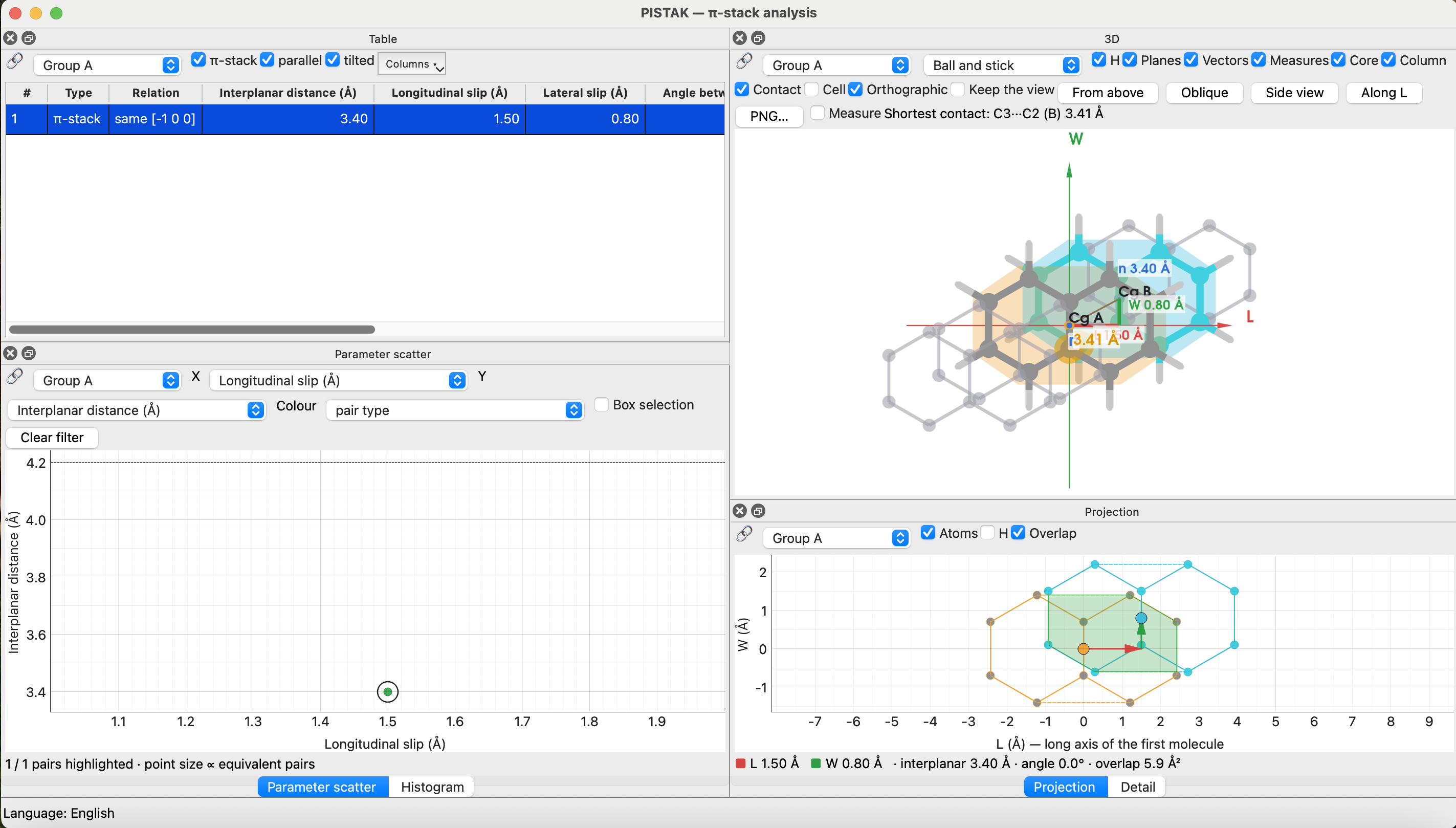
PISTAK is a Python application that analyses π-stacking in crystal structures read from CIF files. It measures interplanar distance, slip, tilt angle and overlap, and shows the results in synchronised tables, plots and 3D views.
PISTAK is a stand-alone Python application for the analysis of π-stacking interactions in crystal structures. It reads CIF files, rebuilds the whole molecules from the symmetry operations and finds every pair of neighbouring π fragments. It then classifies each pair as stacked, parallel or tilted, and measures interplanar distance, longitudinal and lateral slip, dihedral angle, ring-centroid distance and core overlap. It started from the algorithm of the "π-stack analyser" on moleculesfriends.eu, and in website-compatible mode it reproduces that tool’s numbers.
On top of the website’s analysis, PISTAK adds:
- stack columns, layers and 3D networks;
- Janiak-style ring-pair tables (Cg···Cg, α, β, γ);
- signed slips and a long axis that can be set from two atoms;
- uncertainties (σ) from a Monte Carlo over the standard uncertainties in the CIF.
It also includes tools for the whole structure:
- quick checks in the style of checkCIF (formula, density, hydrogens, missed symmetry);
- bonds, angles, torsions and van der Waals contacts with symmetry codes and s.u.
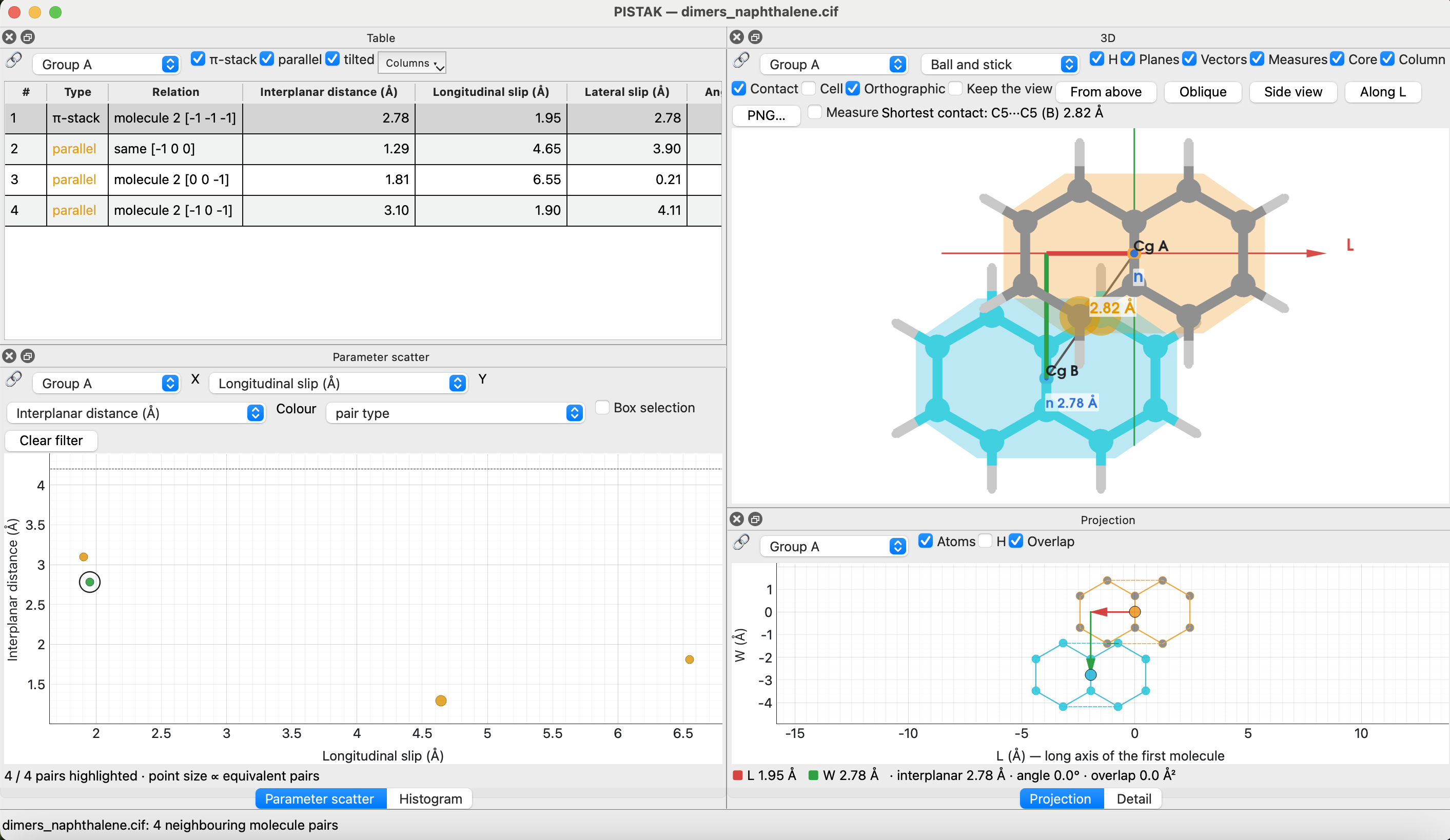
The graphical interface has linked views: table, parameter scatter, histogram, 3D, projection and detail. Selecting a pair in one view selects it in the others. Thresholds can be changed with live sliders and pairs are reclassified almost instantly. In 3D you can measure distances and angles between atoms. Whole folders of CIF files can be compared, with statistics, correlations and a “motif distance” between stacking motifs.
For computational chemistry, any pair can be exported as a dimer input for ORCA, Psi4 or Gaussian, as DFT-D with counterpoise correction or as SAPT (Psi4). The whole cell can be exported for VASP, Quantum ESPRESSO, CP2K or CRYSTAL.
PISTAK also works from the command line (analyze, batch, compare, stats, qc, check, geom, periodic) and as a Python library. Its output goes to CSV, JSON and XYZ with fixed column names. Sessions can be saved and reopened, new parameters can be added with plugins, and the interface and the manual are available in English and Italian.
Screenshots
Opening window with pre-loaded example
Naphthalene pi-stack
Updates
v1.4.0
π fragments only from sp²/sp rings. Until v1.3.1 a fragment was any system of fused planar rings, so a planar saturated ring (cyclobutane on an inversion centre, an sp³ chelate ring), a cage triangle or a cyclopropane could become a fragment, and an aromatic ring fused to a saturated ring (indane, fluorene) formed one fragment with it. Now (ring_atoms = "sp2", the default) a ring enters a fragment only if it has at least four atoms and every non-metal atom in it has at most three non-metal neighbours (H included, bonds to metals not counted) and, with three, lies in their plane (sum of the three angles ≥ 345°).
ring_atoms = "any" restores the old rule. Site mode keeps it, and the PLATON-style ring list still uses every planar ring.
The one aromatic case left out is cyclopropenium (three-membered ring).
How to cite
Tommaso Francese (2026). PISTAK (v0.0.1) (v0.0.1) [Software]. Zenodo. https://doi.org/10.5281/zenodo.23729797
BibTeX
@software{tommasofrancese_2026_23729797,
  author    = {Tommaso Francese},
  title     = {PISTAK (v0.0.1)},
  year      = {2026},
  publisher = {Zenodo},
  version   = {v0.0.1},
  doi       = {10.5281/zenodo.23729797},
  url       = {https://doi.org/10.5281/zenodo.23729797}
}
Last updated
Become a catalyst
Free tools stay free. A donation lowers the activation energy of the next release.